

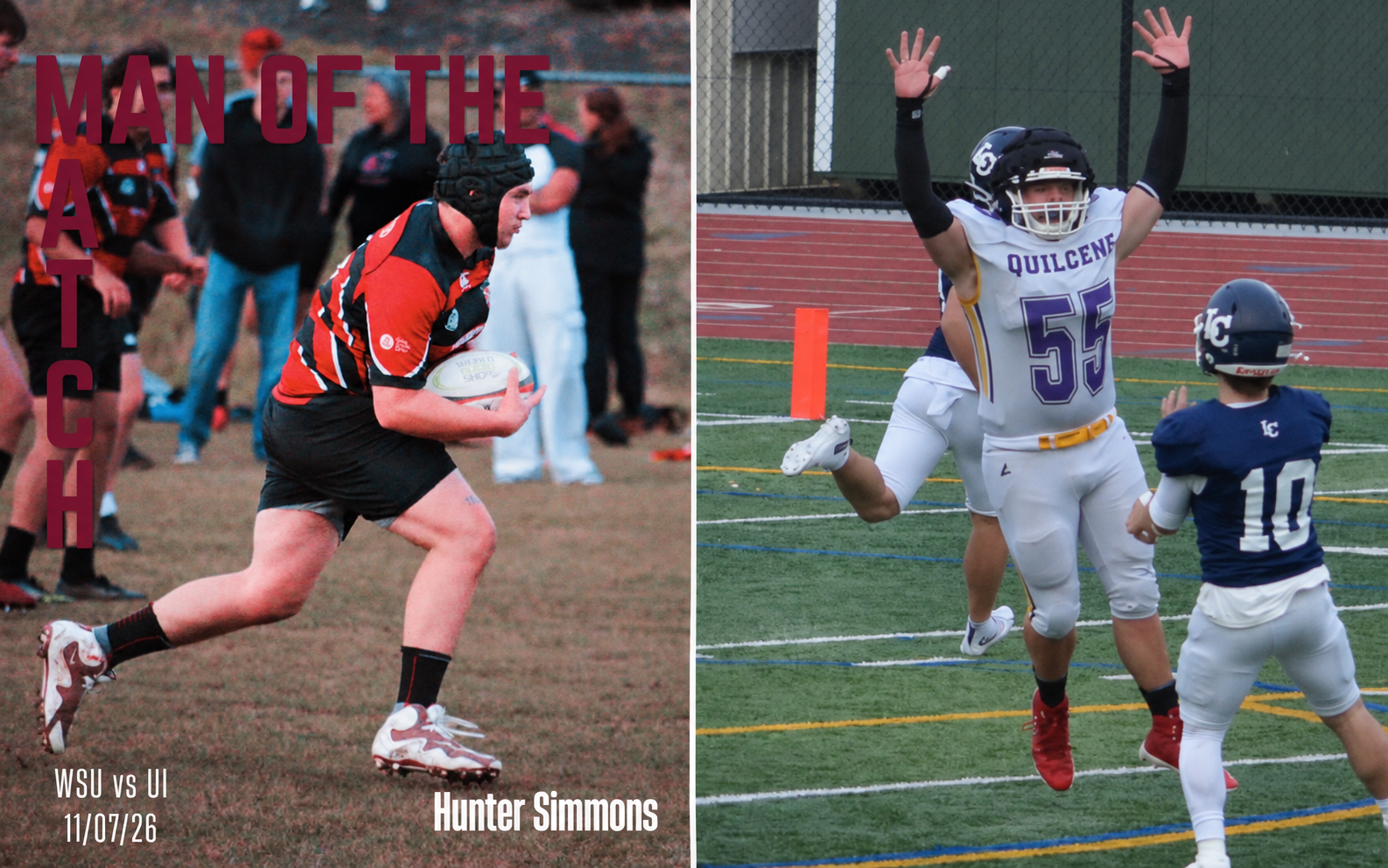
In just his second rugby game, Hunter Simmons found an opening.
Taking a pass near the opponent’s try line, the 2026 Quilcene High School graduate drove through a gap and carried a defender with him into the scoring area. His first try, the rugby equivalent of a touchdown, was a milestone in a sport he was still learning.
Then came another surprise: the opposing team selected him as its man of the match.
For Simmons, the recognition was an early sign that the skills and determination he developed as a Quilcene Ranger could carry him onto a new field at Washington State University.
“It’s just being recognized by another team,” Simmons said, describing what the honor meant to him.
His transition from small-town football to college club rugby began with curiosity, a few YouTube videos and a willingness to reach out.
Watching rugby, Simmons was drawn to its physicality and continuous action. Once he arrived at WSU and began playing touch rugby before the season, he found something beyond the sport itself: a team that made him feel welcome.
“The guys are amazing,” he said. “They treat me as a brother, and I love it.”
Small-school lessons, bigger opportunities
Playing eight-man football in Quilcene taught Simmons that versatility matters.
With a small roster, players cannot always count on someone else being available to fill a position. They must understand different assignments and be ready when the team needs them.
“There’s not always going to be someone that can take a spot,” Simmons said.
That mindset has served him well at WSU. Learning a new sport has required him to listen, adapt and accept unfamiliar responsibilities. His willingness to play wherever needed has helped him earn opportunities and learn more from his coaches.
His experience as a defensive end also gave him a useful foundation. Covering open space, reading a developing play and deciding when to make a tackle were familiar challenges.
But rugby quickly introduced a different demand: after the tackle, the work keeps going.
In football, a whistle generally brings a pause and a chance to reset. In rugby, Simmons has had to learn to get back to his feet immediately and rejoin the action, whether that means making another tackle or carrying the ball.
The conditioning was an eye-opener.
“I didn’t believe you until I actually had to do a Bronco,” he said, referring to a demanding shuttle-running fitness test used in rugby.
“Sometimes you want it to, but it doesn’t stop.”
That challenge has become part of the appeal.
“It’s continuous,” he said. “I love it.”
Doing the heavy lifting
Simmons plays prop, a position among rugby’s forwards, the group responsible for much of the close-contact work, including the scrum.
For readers more familiar with football, Simmons compares the distinction between forwards and backs loosely to the difference between linemen and receivers. The forwards handle much of the heavy lifting, while the backs often have opportunities to attack in open space.
But size alone is not enough.
Props must also move, tackle, carry the ball and keep contributing throughout the match. For Simmons, the position combines the physical play he enjoys with the endurance he is still developing.
His first try showed how those responsibilities can come together. Working within WSU’s attacking formation, he received the ball, spotted a gap and powered through it.
Scoring in only his second game and earning recognition from the opposition afterward gave him a moment to measure how far he had already come.
Remembering who helped him get there
As Simmons builds a new athletic life in Pullman, he remains quick to recognize the people back home who helped prepare him.
He credits his longtime football coach, Trey Beathard, who worked with him beginning in eighth grade, and Justin Matheson, who answered his early rugby questions and helped introduce him to the game.
He also pointed to former teammates Isaac Figueroa and Tyler Matheson. Trying to keep pace with faster teammates pushed him to improve and taught him persistence.
His family remains a steady presence. His mother has supported him from the sidelines, his father helped coach during his football years, and his grandparents continue to make the effort to watch him compete.
His parents and grandparents recently traveled to see him play at WSU, bringing a familiar piece of home to his new sport.
“Just go out and do it”
Simmons’ advice to young athletes in Brinnon and Quilcene is straightforward: take the first step.
“Just go out and do it,” he said. “The worst thing they can say is no.”
For him, that step was a message to WSU Rugby’s Instagram account asking whether he could play. Conversations followed, along with a chance to meet members of the program at Washington’s high school rugby championships.
Those early connections helped make the move to college less intimidating. By the time he arrived, he already knew people on the team.
He hopes other small-town athletes recognize that opportunities to keep competing can include college club sports.
Supporters can follow WSU Rugby on Instagram for schedules, game updates, photos and man-of-the-match announcements. At the time of the interview, Simmons said the team did not have a regular livestream, although some opponents provide game coverage.
For now, he is focused on learning, improving and making the most of the opportunity he asked for.
A few months removed from Quilcene High School, Simmons has already found a new team, scored his first try and earned an opponent’s respect.
And he has brought his Ranger roots along for every tackle.